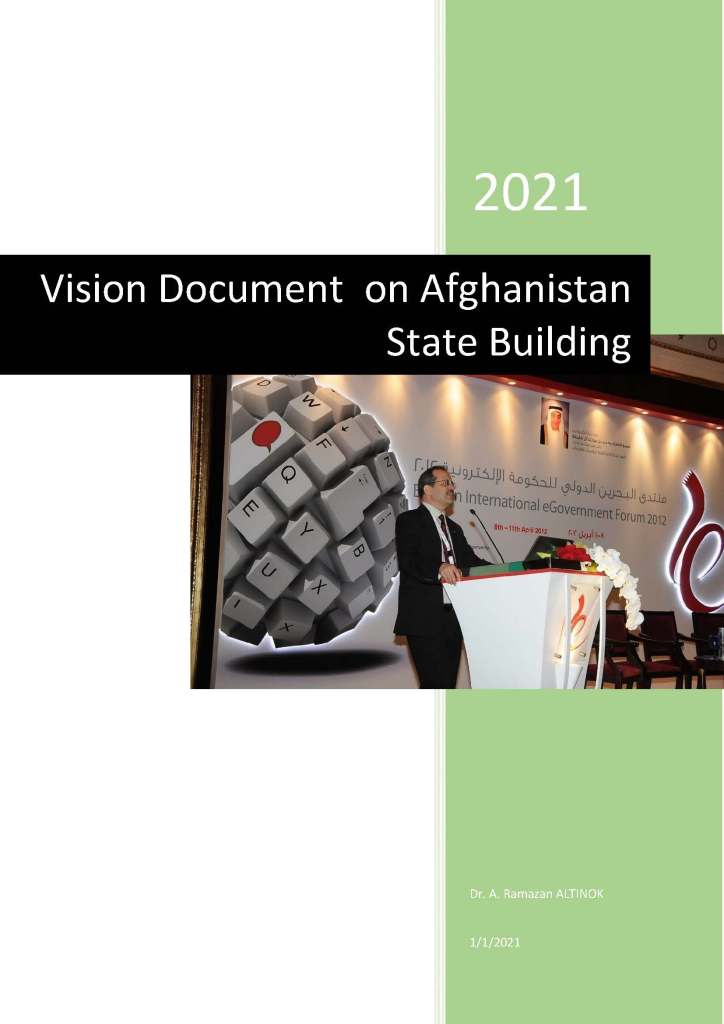
Topic: An outline of project proposal for Afghanistan Public Management Reform
Afghanistan has suffered from long term war devastation not only in physical infrastructure, but also administrative structure of the state.
After the American invasion and reinstating of -an artificial government-, dependent on the American financial aid, could not meet the expectations of the citizens. Lack of meritocratic human resources and as well as widespread corruption, nepotism and cronyism, t can be said that generations started from eighties (Soviet invasion), i.e. around 40 years, have not tasted a running governmental system.
Therefore, we can conclude that, regardless of the basic human needs (food, water, security etc.), most crucial need for the Afghan people is “having a running state, an administrative machine” that is in the service of the people. Even basic needs, such as security, food and water supply cannot be performed without a running governmental framework.
On the other hand, Turkey has been maintaining a state tradition which is going back to 1000 years or more. One of the few Muslim countries, not suffered from foreign invasion, and sustained its well-established state administration tradition and mechanism till now.
After coming into power in Turkey, The Justice and Development Party, adopted a comprehensive reform package in 2002 which was called “Acil Eylem Planı”1,or “Emergency Action Plan for Re- Structuring the Government Services”.
The Package consisted a well-designed “Public Management Reform” package inside it, which was
coded with KYR (Kamu Yönetimi Reformu), i.e. Public Management Reform.
Among these KYR Reform Articles, KYR-22 denoted an “e-Transformation Project”. Which is a visionary project to transform government services from paper based red-tape style archaic model into modern electronic government.
State Planning Organization (SPO or DPT) was assigned to develop Information Society Strategy 2for 2006-2010 years to implement such a big project, and before the publication of this strategy, a short-term Action Plans for 2003, 2004-2005 years has been implemented and coordinated by the State Planning organization.
However, SPO not being an executive body, the aspiration of the Strategy could not be realized as it was supposed to. Although, Experts suggested a powerful executive body under Prime Ministry, to coordinate all e-government projects, this was not appreciated and implemented by the government, in spite of a section to establish an CIO (Chief Information Office) at the Prime Ministry.
1 Please see attached Document “Acil Eylem Planı”, Emergency Action Plan of AK Party published in 2002
2 Please See the copy of Turkish Information Society Strategy.
By the author of this proposal3, it was observed that, all successful e-government leading countries in the world (South Korea, Singapore, Estonia etc.) created a body consisted of highly specialized experts from different ministries under the name of Chief Information Office.
Without a powerful executive body emanating its power from the highest administrative authority, (whether it is Prime Minister or the President depending on the political system)
Without any practical advancement and the standstill of the 2006-2010 S strategy in terms of e- government project, a group of advisors submitted a solution to the Prime Minister’s Office to move the reform package and to enliven the public management in 2007 December.
After the acceptance of the proposal, a WorkForce under the name of e-Government Advisory
Board was created at the Prime Minister’s Office.
The WorkForce or eGovernment Advisory Board, adopted an institutional innovation model to utilize best personnel of the line ministries as secondees in the group. The model was scientifically applauded and became a discussion topic in international academic circles, as well as awarded with several innovation awards. 4
Although, it was not a permanent structure to play the role of CO Office as in the example of the advanced e-government countries, it has achieved big success, by prioritizing 11 most vital projects to put e-government agenda on the country.
The eGovernment Work Force is deployed under the “Public Administration Development Department” of Prime Minister’s Office5, leveraged the already declared e-government projects in the National information Society Strategy6 in addition to prioritizing 11 urgent e-government project which is crucial for the public need and has potentially widespread effect on combatting the red tape (bureaucracy).
And, till 2016, around 33 big projects were achieved in Turkey, from Justice to interior Ministry, from e-Signature to the e-Notification Project. And Turkey became leader of e-Government in the region later proved by many international awards.
Out of 33 Project, 1 was dedicated to share Turkish success stories with friendly countries in the region.
Head of eGovernment Advisory Group, took an initiative to help target countries in the form of Technical Assistance by utilizing the Power of TKA (Turkish Cooperation Agency) in transferring the Turkish know-how of worth billions of dollars, to inoculate to other countries in order to save them from re-inventing the wheel and avoiding them from making costly mistakes Turkey had already done during her reformation process between 2002-2009.
the Project document was developed in 2009 by the participation of TIKA7, TODAE (Public
Management School) and Prime Ministry’s Foreign Relations Department. 8
Project 33, or SEG piloted Syria as a target country, and most energy spent to transfer Turkish success stories to Syrian case. By highly appreciation of Syrian Minister of Communication and his support, a great deal of training and project implementation activities realized between 2009- 2011 till the civil war erupted in the country.
Another success was achieved with Moldovan government, by exchanging experts for long term training and high-level project implementation education.
As part of SEG, by the initiative of eGovernment Group, a special unit at TODAE9 under the name of e-Government Study Center was established.
A worldwide conference under the title of eGOV Share was held in Antalya, which brought together almost all e-government leaders and practitioners all over the world.10
A Table which SEG is implemented in the following Table 11.
| Cooperated Country | Achievements | Reason | Explanation |
| Syria | Highly Successful | Support of Minister in Syria | Minister of CT, personally owned the project and gave full support. |
| Moldova | Successful | UNDP and WB support | Very keen team of e-Government, Support from the World Bank is the key indicators of the success. |
| Saudi Arabia | Successful | Financial Support from Saudi Government | |
| Yemen | Unsuccessful | We could not provide enough sources although it was demanded by the Prime Minister of Yemen |
7 A Short Note About TIKA Legislation (Turkish International Cooperation Agency)
MADDE 522 – (1) Başkanlığın görevleri şunlardır:
…..
b) İşbirliğinde bulunulmas hedeflenen ülke ve topluluklarn iktisadi gelişim sürecinde ihtiyaç duyacaklar ekonomik altyapı araçlarn ve destek programlarn hazrlamak, ekonomik büyüme, yatırım ortamının hazırlanması ve geliştirilmesi, işsizliğin ve yoksulluğun azaltılması, eğitim seviyesinin yükseltilmesi, iyi yönetişim, kadın ve ailenin toplumsal yaşamda ve kalkınmadaki rolü, bilgi teknolojileri transferi, çevre ve doğal kaynaklarn yönetimi, enerji, altyapı, sürdürülebilir kalkınma gibi alanlarda katkı temin etmek, bu ülkelere kurumsal, insan kaynaklar ve benzeri alanlarda kapasite geliştirme destekleri sağlamak.
d) İşbirliği yaplmas hedeflenen ülke ve topluluklarda kamu yönetimi, hukuk, eğitim, kültür ve diğer sosyal alanlardaki işbirliğini güçlendirmek amacyla proje ve programlar hazırlamak, hazırlatmak ve uygulamak, bu ülke ve topluluklardan eğitim ve staj amacyla Türkiye’ye gönderilecek kamu görevlileri ve diğer kişilere burs ve benzeri destek sağlamak.
8 Please see attached SIEG Presentation and Project Document.
9 A Short Note About TODAIE Mission:
Türkiye ve Orta Doğu Amme İdaresi Enstitüsü(TODAİE), 8 Mayıs 1952 tarihinde Türkiye ve Birleşmiş Milletler arasında varolan teknik yardım anlaşmasına ek bir protokol ile kurulmuş, 1958 yılında 7163 sayılı Kuruluş Kanunu ile bilimsel, mali ve yönetsel özerklik ve tüzel kişilik kazanmış, bu yeni yapısını geliştirerek günümüze kadar gelmiştir.
TODAİE, 1992 yılından bu yana, merkezi Brüksel’de bulunan Uluslararası Yönetim Bilimleri Enstitüsü’nün (International Institute of Administrative Sciences – IIAS) Türkiye Ulusal Sorumlusudur. TODAİE, Uluslararası Yönetim Okulları ve Enstitüleri Birliği’nin de (International Association of Schools and Institutes of Administration – IASIA) üyesidir. Enstitü bu özellikleriyle, kamu yönetimi
alanındaki ulusal birikimini uluslararası platformlarda değerlendirmeyi ve başka ülkelerin birikimlerin- den yararlanmayı amaçlamaktadır. (The institute was merged with Haci Bayram University in 2018)
| Iraq | Unsuccessful | We could not submit enough interest although Prime Minister of Iraq was very positive | |
| Iran | Partly Successful | Deputy Minister of ran, personally visited Turkey after we submitted project to him in Tehran. | Turkish government did not meet the demands of ran, based on the sanctions-imposed ran by the UN on these years |
| Turkmenistan | Unsuccessful | Turkmenistan government did not show any interest and looked at the project suspiciously. | |
| Uzbekistan | Unsuccessful | Although, UNDP branch in Tashkent interested in our project and appreciated it very highly, Uzbekistan government did not show any interest | State to State political crisis at the mentioned dates, prevented us to move forward with Uzbeks |
| ESCWA and Lebanon | Very Successful | ESCWA is a branch of UN based in Beirut, responsible for developing public management capacity of Arab countries, highly appreciated our initiative, and visited Turkey with a high-level expert, and adopted our cooperation motto. | ESCWA was very keen to implement our vision, however, it was in2014-15 term, where eGoverment Work Force is not supported by the new Undersecretary of the time, by not allowing new experts secondment from other ministries. |
| Azerbaijan | Successful | We helped them to formulate Information Society Strategy | |
| OIC | Successful | Mr. Ekmeleddin İhsanoğlu personally listened our project, and employed SESRIC to support it. An e-government working group for Islamic Countries were established and Turkey’s eGov Working Group were selected head of this group unanimously, ran and Malaysian delegation was appointed as deputies. | SESRIC supported our project, however, it was in 2015, and e- Government Group was dissolved by the order from new undersecretary of the Prime Minister. |
Reform
Public Management Reform: e-Government Reform
Therefore 14 years of experience of experts can be easily activated in Afghanistan, with some localization.
ANALYSIS of RISKS AND CHALLENGES
question mark.
SIEG project, TIKA and PM’s Budget is used for per-diems of the actors, and training was conducted at TODA’s e-Government Center. But, now, the skilled staff members are not in a unified organization umbrella, there is no TODAE anymore, it was dispersed. And also, some new members as well as some international experts from private sector needs to be involved in the new team.
Having both Turkish and international expertise, as well as having worked as the UNDP and WB projects, may indicate the following steps to be taken for Afghanistan State Building and Public Management Reinvigoration Project (ASPMRP):
In short,
We can have eligibility and capability of establishing, managing and implementing such a comprehensive project, and ready to further discuss and present our views in future.
Following References have been studied as a theoretical and experiential base to formulate above vision document in addition to field expertise shown in the photograph section:
Francis Fukuyama, State Building
Richard Heeks, Developing and implementing e-Government Jane Fountain, Digital Governance
Burak Erdim, Middle East Technical University and Revolution: Development Planning and Architectural Education during the Cold War, 1950-1962
Dobbins, James, et al. The U.N.’s Role in Nation-building: From the Congo to Iraq.
Santa Monica, CA: Rand Corporation, 2005.
Dobbins, James, et al. America’s Role in Nation-Building: From Germany to Iraq. Santa Monica, CA: Rand Corporation, 2003.
Ramazan Altinok, EU and Turkish Public Management Reform, A Model Proposal for Turkey (Master’s
Thesis)
Ramazan Altinok, implementing e-Government in Provincial Administrations in Turkey (M.P.A Thesis)
Ramazan Altinok, implementing e-Government in Local Administrations in Turkey (M.Sc. Thesis, the UK)
Ramazan Altinok, e-Participation, a new Model Post Modern Democracy, PhD Thesis.
An Internationl Comparative Study on e-Legislation, RECIPA Publications, Ankara (ISBN: 978-605- 62416-1-1)
New trends in e-Government: A Global Comparative Study, RECIPA Publications, Ankara (ISBN:978- 605-62416-0-4)
Altinok A.R and Yildiz M. (2010) Sharing Expreinces&Know-how on e-Government: Selected e- Government Projects in Turkey, Ankara:Turkish Cooperation and Development Agency
OECD (2007) OECD e-Government Studies Turkey, Paris: OECD.
OECD(2006)“e-Government Studies:Turkey”, OECD e-Government Peer Review, Ankara:SPO Publication No:2726
Altinok Ramazan, Section Author of; State Planning Organization (SPO) (2006) “National Information Society Strategy (2006-2010), the Chapter on the Governance Model and Institutional Structure of e- Government Management, Ankara: SPO Publication No:2698, 44-46.
Altinok Ramazan, Section Author of ; State Planning Organization (2006) “National Information Society Strategy Action Plan (Turkish Version) (2006-2010) Chapter on the Governance Model and Institutional Structure of e-Government Management), Ankara: SPO Publication No:2699, 28-29.
Altinok Ramazan, Section Author of ;SPO (2006) “National Information Society Strategy Action Plan (English Version) (2006-2010) which is on the Governance Model and Institutional Structure of e- Government Management), Ankara: SPO Publication No:2699, 45-46.
Altinok, R. A ve Kaya Bensghir T (2005) Chapter About “e-Local Goverment Questions in Turkey”, “Contemporary Treatises On Local Government in Turkey-I”, Ankara: Nobel Printing House, 675-715.
Kaya Bensghir, T. ve Altinok A. (2007) “ Impact of Internet on Inter-family relations” in “Family Concept in Our Age”, Istanbul: ISAV, Publication No:49, 625-674.
Altinok, A.R. (2005) “The Challenges of e-Government Strategy Development in Turkey” in
“Reorganization of the Public Management in the Information Age-I, Istanbul: Beta Publication, 133- 167.
Kaya Bensghir T, Altinok A.R, Yüksel, F. ve Tekinkus, M. (2005) “Expectations of Turkish Citizens and Provincial Managers for e-Government”, Building e-Governance, Challanges and Opportunities for Democracy, Administration and Law, Ed.: Pan Suk Kim ve Whasun Jho, Korea: IIAS”, 229-246.
Altinok, A.R. (2004) e-Government as an Instrument of Delivering Quality; Survey on Perception of Citizens and Public Administrators, 3rd Congress of Quality on Public Administration, Ankara:TODAIE, 512-543.
Altinok, A.R. (2002) “Tokat, Nature-History and Culture”, Touristic City Promotion Book in English and Turkish, Tokat:Tokat Governor’s Office
An interview with Kelly Ng, FutureGov Magazine, on future vision of e-Government, Turkey, published in 2 March 2010 issue of FutureGov
http://www.futuregov.asia/articles/2010/mar/02/Turkey-GCIO-reveals-success-citizen-ID/
Yildiz , M. Altinok, A.R and Sadioğlu, U. (2010) Managing e-Government Innovation in Turkey: The Case of e-Government Advisory Group in the Office of the Prime Minister, EGPA, Innovation in Public Management, Erasmus University, the Netherlands.
Altinok A.R. (2005) “A comparative Study on e-Local Government Projects in Turkey and the UK”, Journal of Turkish Public Manager’s Voice, Ankara, August-September, 2005, 20-23
Altinok A.R. (2004) An Interview with A.Ramazan ALTINOK on e-Government, by Zafer Yilmaz,
“Journal of Liberal Thinking, 9 (33), 213-224.
Altinok A.R. (2004) “A review of Public Management Reform Bill from the perspective of e-
Governance”, Journal of Liberal Thinking (available online at http://www.liberal.org.tr, (24.03.2004)
Altinok A.R. (2001) “Internet, Democracy and State” Turkish Public Administration Journal,
December 2001, No 433, pp 137-165
Altinok A.R. (2001) “A local government reform from yesterday to today in the harmonisation
process to the E.U” ” Journal of Local Government, 2 (5) 10-26.
Castells M. (1989) “The Informational Mode of Development and the Structuring of Capitalism Oxford: Blackwell, 1989 (Translator: A. Ramazan Altınok 7-32”), Silk road Journal, Konya
Altinok A.R. (1999)“Do we buy computer software or time-bomb? Journal of Turkish Law Institute, 4 (39) 21-24.
Altinok A.R. (1998) “Reforming Legal Systems in Developing and Transition Countries”, Journal of
Turkish Public Administration, 70 (418), 101–107.
Altinok A.R (1997) “Our Public Administration Sytem visa-vis Information age”, Journal of Turkish
Public Administration, 69 (417), 225-234.
Altinok A.R. (1997) “Local Administrations and Local Education Problem”, Journal of Turkish Public Administration, 69 (415), 113-129.
Altinok A.R. (1996)“Importance of Aftersales Service and Quality in Software Sector”, Journal of
Turkish Public Administration, 68 (412) 203-213.
Danish Ministry of Interior (1996) “Local Administrations and Education in Denmark”, (Translator:
A.R. Altınok), Journal of Public Manager’s Voice, 10 (59), 57-60.
A distinctive PhD Thesis on Turkish Development Policies , Middle East Technical University and Revolution: Development Planning and Architectural Education during the Cold War, 1950-1962 By Burak Erdim
İs highly recommended. To find a particular selection of the topics that supports our vision
documen, please see the following pages:
Pages 97-100,
Chapter Three:Role of Experts, 1954-1955
Pages :140-210
239, 265, 279,
P. 280, 298,
All the documents, power point presentation, strategy development background papers, and personal notes used in Turkish and international e-Government Projects are well kept in our personal archive and are read to be benefitted in proposed project. These priceless materials are to be utilized in our project, if our proposal is adopted by the office of President.
A Short Note About Başbakanlik İdareyi Geliştirme Kanunu:
Legal Basis of e-Government Advisory Group:
BAŞBAKANLIK TEŞKİLATI HAKKINDA KANUN HÜKMÜNDE KARARNAMENİN DEĞİŞTİRİLEREK KABULÜ
HAKKINDA KANUN (1) Kanun Numarası : 3056 Kabul Tarihi : 10/10/1984 Yayımlandığı R. Gazete : Tarih : 19/10/1984 Sayı : 18550 Yayımlandığı Düstur : Tertip : 5 Cilt : 24 Sayfa : 29
İdareyi Geliştirme Başkanlığı:
Madde 16 – İdareyi Geliştirme Başkanlığının görevleri şunlardır:
R.A)
Kamu kurum ve kuruluşlarındaki personelin görevlendirilmesi: (1) Madde 36 – (Değişik birinci fıkra : 27/12/1991 – KHK – 475/6 md.) Genel ve katma bütçeli dairelerle döner sermayeli kuruluşlar, kanunla kurulan fonlarda, belediyeler ve özel idareler, sermayesinin yüzde ellisinden fazlası kamuya ait kuruluşlarda, iktisadi Devlet teşekkülleri ve kamu iktisadi kuruluşlarında ve bunlara bağlı ortaklıklar ve müesseselerde çalışanlar kurumlarının, yüksek yargı organı mensupları, hakim ve savcılar için kendilerinin muvafakatı ile Başbakanlıkta Daire Başkanı ve daha üst ünvanlı kadrolarda istihdam edilebilirler. Başbakanlığın bu konudaki talepleri, ilgili kurum ve kuruluşlarca öncelikle sonuçlandırılır.
Yüksek yargı organları mensupları hakkında görevlendirme talebi ilgili yüksek mahkemelerin başkanlarınca yerine getirilir. Bu personel ilgili kurumundan maaşsız izinli sayılır. İzinli oldukları sürece memuriyetleri ile ilgili özlük hakları devam ettiği gibi, bu süreler terfi ve emekliliklerinde hesaba katılır.
(Ek cümle: 11/10/2011-KHK-666/5 md.) Bu fıkra kapsamında istihdam edilen personel istihdam edildikleri kadro için ilgili mevzuatta öngörülen her türlü mali ve sosyal haklardan aynen yararlanır.
Terfileri başkaca bir işleme gerek duyulmadan süresinde yapılır. (İkinci fıkra mülga: 27/12/1991 – KHK – 475/6 md.) (Ek : 16/6/1988 – KHK – 331/1 md.)
Ayrıca, birinci fıkrada belirtilen kurumlarda görevli personel; aylık, ödenek, her türlü zam ve tazminatlar ile diğer mali ve sosyal hak ve
yardımları kurumlarınca ödenmek kaydıyla geçici olarak Başbakanlıkta görevlendirilebilirler.
A Short Note on TODAIE
TÜRKİYE VE ORTA – DOĞU AMME İDARESİ ENSTİTÜSÜ TEŞKİLAT KANUNU (1) (2) Kanun Numarası :
7163 Kabul Tarihi : 25/6/1958 Yayımlandığı R.Gazete : Tarih : 5/7/1958 Sayı : 9947 Yayımlandığı Düstur
: Tertip : 3 Cilt : 39 Sayfa : 1244
Madde 1 – Amme İdaresinin muasır telakkisine göre gelişmesine yararlı çalışmalar yapmak suretiyle idare sanatında eleman yetiştiren ve memurların idari sahada olgunlaşmasını sağlamayı hedef tutan ve 6139 sayılı kanunla musaddak Teknik Yardım Anlaşması gereğince kurulmuş olan Türkiye ve Orta – Doğu Amme İdaresi Enstitüsü ilmi, idari ve mali muhtariyeti ve hükmi şahsiyeti haizdir.
C) Derleme ve neşriyat:
1. Amme İdaresi sahasında gerek yurt içindeki gerek başka memleketlerdeki hadise ve emsalleri, inkişafları, tatbikat ve hal tarzlarını, araştırma, inceleme ve neşriyatı devamlı olarak takibetmek ve derlemek;
E) Türkiye ve Orta – Doğu memleketlerinde Amme İdaresi sahasında yapılan araştırma ve öğretim faaliyetlerinin koordinasyon merkezi olmak.
Madde 3 – Enstitü, 2 nci maddede yazılı görevlerini başarabilmek için idare ve ilim müesseseleriyle iş birliği yapar. Yurt içindeki bütün mütehassıslardan faydalanır; ilgili milletlerarası kurumlarla ilmi münasebet ve temaslarda bulunur.
Madde 5 – İdare Heyeti aşağıdaki kimselerden terekküp eder:
III – Giriş şartları
Madde 15 – Amme İdaresi Enstitüsünün giriş müsabakasına katılabilmek için üniversite veya yüksek okul mazunu olmak şarttır. Bu şartı haiz bulunan kimseler arasından, idare heyetinin tesbit edeceği esaslar dairesinde yapılacak müsabaka
imtihanını kazananlar Türkiye ve Orta Doğu Amme Enstitüsüne devam edebilirler.
Yukardaki evsafı haiz olup da Devlet dairelerinde, mahalli idarelerde, İktisadi Devlet Teşekküllerinde çalışanlardan müsabaka imtihanını kazananlara tahsil süresince izin verilir. Bu kimseler bütün özlük haklarından faydalanmakta, maaş ve ödeneklerini kendilerine izin veren daire, müessese ve teşekküllerden almakta devam ederler.
Enstitüdeki tahsillerini başarı ile bitirenlerin Enstitüde geçirdikleri müddet kıdemlerine sayılır ve bu müddetin bir katı (1 seneden az olmamak üzere) kıdemlerine eklenir.
Kendi hükümetleri tarafından Enstitüye adaylığı teklif edilecek yabancılar, tesbit edilecek esaslar dairesinde İcra Komitesince öğrenci olarak kabul edilebilir.
Prime Minister’s Office ,
He graduated from the Faculty of Law, University of Istanbul in 1988, obtained lawyership license in 1990, he received his LLM from the University of Istanbul in 1993, his Executive MPA from National Public Management Institute in 2002, and his Msc (MIS) degree from the Middlesex University, London, in 2003. He received his 1st PhD in Economics (E-commerce), and his 2nd PhD in Public Management (e-Participation).
Dr. Altinok has been head of the e-Government Advisory Group at the Prime Minister’s Office since 2007. Responsible from coordination of 33 cross-cutting e-government projects prioritized by the PM. He has also led the e-legislation group established in 2009 responsible from drafting a comprehensive e-legal infrastructure for the country.
He’s lecturing on e-Government at various universities in Turkey. He was awarded the strategic visionary bureaucrat of the year award in 2010 by TASAM, EMEA e-Government Award 2011 and most innovative bureaucrat of the year award in 2011.
Dr. Altinok assumed presidency of the e-Government Working Group of OIC Countries in July 2011. He consulted Syrian, Saudi Arabian, Mauritanian, Turkmenistan, Kosovan and Moldovan governments on e- Government and Public Management Modernization Projects.
He’s also consulting a think tank (RECIPA) located in Istanbul aimed promoting “good governance” in Turkey and regional countries. He is fluent in English and Arabic, and intermediate in Persian.
His public profile is available at: http://tr.linkedin.com/in/ramazanaltinok
Role of Multi-disciplinary approach and using collective mind model in the success of e-Government Group:
Someone who does not know the legislation of TODAIE, the Prime Minister’s Office andTIKA, i.e. who does not have administrative and legal infrastructure, cannot carry out the SIEG project. It’s not an easy task that a computer technician or engineer wou